How to Start Speaking Polish Quickly? Discover Our Learning Method.
6 Mar | 2026
Have you ever wondered why after some foreign language lessons you feel a surge of energy, and new words seem to form sentences on their own? At Varia Polish Language Center, we know that effective learning is neither a matter of chance nor of “talent.” It is the result of a carefully designed process in which we combine authentic relationships with modern teaching methods. Our mission is to guide you through the intricacies of the Polish language so that you begin to speak correctly, effectively, and – most importantly – with genuine pleasure. In this article, we take a look “under the hood” of our courses. You will learn how we make Polish grammar easier to master, why intensity is your ally, and what we do to ensure that from the very first minute you feel with us like among friends.

Table of Content:
- Our philosophy: communication as a priority
- Intensive courses: why does daily learning of Polish work?
- Grammar as a Tool for Success (and Our Lifeline)
- The Anatomy of the Perfect Lesson: Dynamics and Interaction
- A Lesson Like Meeting Friends: The Power of Relationships and the Absence of Barriers
- Assessing Knowledge Without Unnecessary Stress
Varia Online: Virtual Classroom, Real Quality- Why Is It Worth Trusting Us?
Our Philosophy: Communication as the Priority
The foundation of learning at Varia is a simple principle: language is meant for action. In teaching Polish, we use the communicative method, which means that every new element introduced – whether a word or a grammatical structure – is immediately used in conversation.
We do not rely on half-measures. Even at the A1.1 level, we “immerse” our students in Polish. From the very first minutes, we familiarize the group with the natural sound of the language by introducing essential “survival phrases” (e.g., “Can you repeat that?”, “What does it mean?”). This approach quickly removes the speaking barrier and the need to switch to English.
Intensive Courses: Why Does Learning Polish Every Day Work?
In our offer, intensive Polish language courses play a key role. They are designed for people who want to quickly overcome the language barrier. Although the pace may resemble a “bootcamp,” the format of the classes remains light and supportive.
Minimizing forgetting: Because lessons take place every day, the forgetting process is almost eliminated. Knowledge doesn’t have time to fade between classes, and each subsequent lesson builds on the solid foundations from the previous day.
Daily strategic revision: Each session begins with a 10–15 minute review segment. This is the time to organize knowledge and clarify any doubts “while they’re still fresh” before moving on to new material.
Friday conversation classes: These are our favorite days. We focus exclusively on fluency, using vocabulary from the entire week in relaxed discussions and language games. It’s the moment when students clearly see that their effort has paid off.

Grammar as a Tool for Success (and Our Lifeline)
For many foreigners, Polish grammar can seem like an insurmountable challenge. At Varia, we break that myth. We don’t teach rules for the sake of rules—grammar is a survival tool for us. We explain cases and conjugations in real-life contexts: at the bakery, at the post office, in an office, or during business negotiations.
Additional support: We know that sometimes you need theory in a nutshell. Our “lifeline” is the course “Polish Cases Explained.” Why are they so important? Because in Polish, it’s the endings that build the logic of a sentence—without them, it’s hard to determine who is performing an action and who is affected by it. This course will help you quickly organize the language system and feel more confident in everyday conversation.
The Anatomy of a Perfect Lesson: Dynamics and Interaction
A lesson at Varia has its own rhythm, which makes 90 minutes pass in the blink of an eye. We avoid monotony and passive sitting at desks.
Active warm-up: We start with small talk, which not only warms up the vocal cords but also builds group rapport and helps students “switch into” Polish.
Pair and group work: This is the heart of our lessons. Instead of focusing only on the teacher, students interact with each other. This encourages creativity and ensures that every participant speaks for most of the class time.
Quick check-up: We value brief summaries. A quick quiz or a round of questions at the end of the lesson gives a clear sense of achievement: “I know what I’ve learned today.”
Real-life materials: We don’t limit ourselves to textbooks. We analyze real menus, social media posts, and fragments of Polish songs. We teach you the language you actually hear on the street.
Independent discovery (induction): The teacher doesn’t simply hand you ready-made rules. Instead, they guide the lesson so that you “discover” grammatical patterns yourself based on examples. These “aha!” moments make the knowledge stick much longer.
A Lesson Like Meeting Friends: The Power of Relationships and the Absence of Barriers
The atmosphere is not just a “nice addition” — it is a necessary condition for overcoming the language barrier.
Reducing distance: From the very first lesson, we use first names. Being on a first-name basis with the teacher and the group immediately lowers stress levels and makes communication more natural.
A sense of humor and perspective: We love to laugh during lessons! Humor helps relieve the tension that comes with learning difficult structures. Our teachers bring genuine enthusiasm to the classroom, which quickly spreads to the group.
Energy monitoring: Boredom is a red flag for us. If the teacher notices a drop in concentration, they immediately shift the dynamics—introducing movement, interaction, or a short language game.
We see each other: We’re not just a group of people in one room—we’re a small community. We notice one another, celebrate successes, and when someone has a birthday, we sing “Sto lat!” together. This creates a sense of belonging that makes you want to keep coming back to Varia.

Assessing Knowledge Without Unnecessary Stress
At Varia, we regularly check your Polish language knowledge, but not to judge anyone. Final tests are, for us, a confirmation of your progress and an opportunity to celebrate reaching the next level.
Support instead of stress: A test is meant to show what you already know and what still needs work. If the result is lower, we don’t treat it as a failure, but as a signal that it’s worth revisiting certain parts of the material before moving on.
Quick response: If you feel that the group’s pace is too fast or too slow for you, we respond immediately and discreetly. Your satisfaction and sense of meaningful progress are our priority—we address issues “here and now.”
Varia Online: A Virtual Classroom, Real Quality
Our online Polish courses are not a “backup plan” – they are a modern, fully-fledged product. We use a digital toolkit that makes learning through a screen just as engaging as in a classroom.
We use interactive tools (Wordwall, Quizlet, Kahoot), take advantage of breakout rooms for pair work, and strongly encourage students to keep their cameras on. Eye contact and facial expressions are essential for building connections and better understanding the language, which is why we make sure our virtual classroom is full of life.
Why Is It Worth Trusting Us?
We have a modern school, professional classrooms, and vibrant, high-energy social media that showcase our everyday life. But behind every Instagram photo stands solid, methodologically sound work. We don’t want the reality in the classroom to differ from what we promise online.
At Varia Polish Language Center, every student comes with a different goal—from obtaining the Karta Polaka, to working in a Polish team, to simply being able to order a coffee at Kraków’s Main Square with ease. Our strength lies in recognizing these goals and helping you achieve them. With us, you’ll simply start speaking.
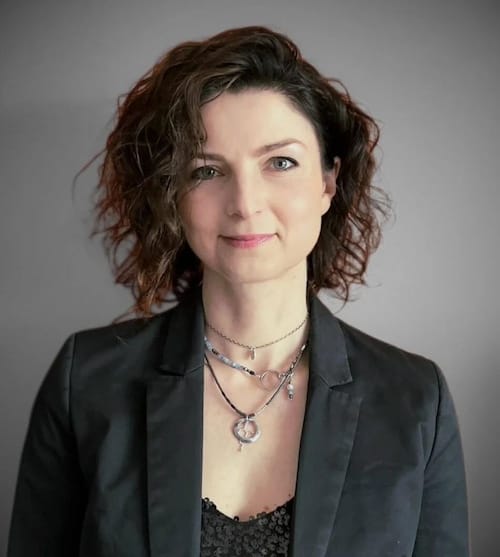
The author of this article is Katarzyna Hoffmann, co-owner of the Varia Polish Language Center in Kraków. She graduated in German Philology from the Jagiellonian University in Kraków.